
Sampson County Projected Release Meaning
North Carolina uses the exact field label Projected Release Date. It is a calculated future or anticipated date tied to the sentence information currently recorded by NCDAC. Once a state prison release has occurred, sentence history may instead show Actual Release Date. The two fields can match, but they answer different questions. A projected date states what the present calculation anticipates. An actual date states when the sentence record says that custody event occurred.
Read the date beside incarceration status, supervision status, sentence service status, and Last Movement. A movement labeled EXPIRATION with a matching actual date is strong evidence that the identified state custody term ended. A transfer-like movement points to another custodian and should not be restated as freedom. Active community supervision after inactive incarceration means the prison episode ended while probation, parole, or post-release supervision remains.
Scheduled vs actual release: A projected date may change. Use an Actual Release Date or the custodian's release record to confirm that release occurred.
A pretrial detainee at Sampson County Detention Center normally has no sentence-derived projected date. Bond, court action, dismissal, or later sentencing controls that case. Even a posted bond entry is not proof that all release processing is complete. For a locally sentenced jail term, ask the jail and court for the operative calculation because the public NCDAC locator may not cover it.
Find a Sampson County Projected Release
Start with the custody system that imposes or manages the sentence. For a North Carolina state prisoner, use the NCDAC Offender Search. It covers state prison and Community Supervision records, including historical records back to 1972. It does not supply local jail records for a person who only left Sampson County Detention Center. Search All first because a person can leave prison yet remain active under community supervision.
- Choose All and search by offender number when known. Name and public identity filters can narrow a match.
- Open the offender number only after matching public identity details. Remove any uncertain filter that may hide the right record.
- Read incarceration and probation, parole, or post-release status separately.
- Locate Projected Release Date, then inspect sentence history, detainers, Last Movement, and any Actual Release Date.
- For a county detainee or local jail sentence, call the detention center or request the existing release and calculation record.
The NCDAC search help says offender number is the fastest route and leading zeroes may be omitted. A namesake should never be selected from name alone. The broader Sampson County release-record path covers county booking sheets, court disposition, and transfer confirmation when the NCDAC search is the wrong channel.
The official NCDAC form shows the search modes used to locate a state record.
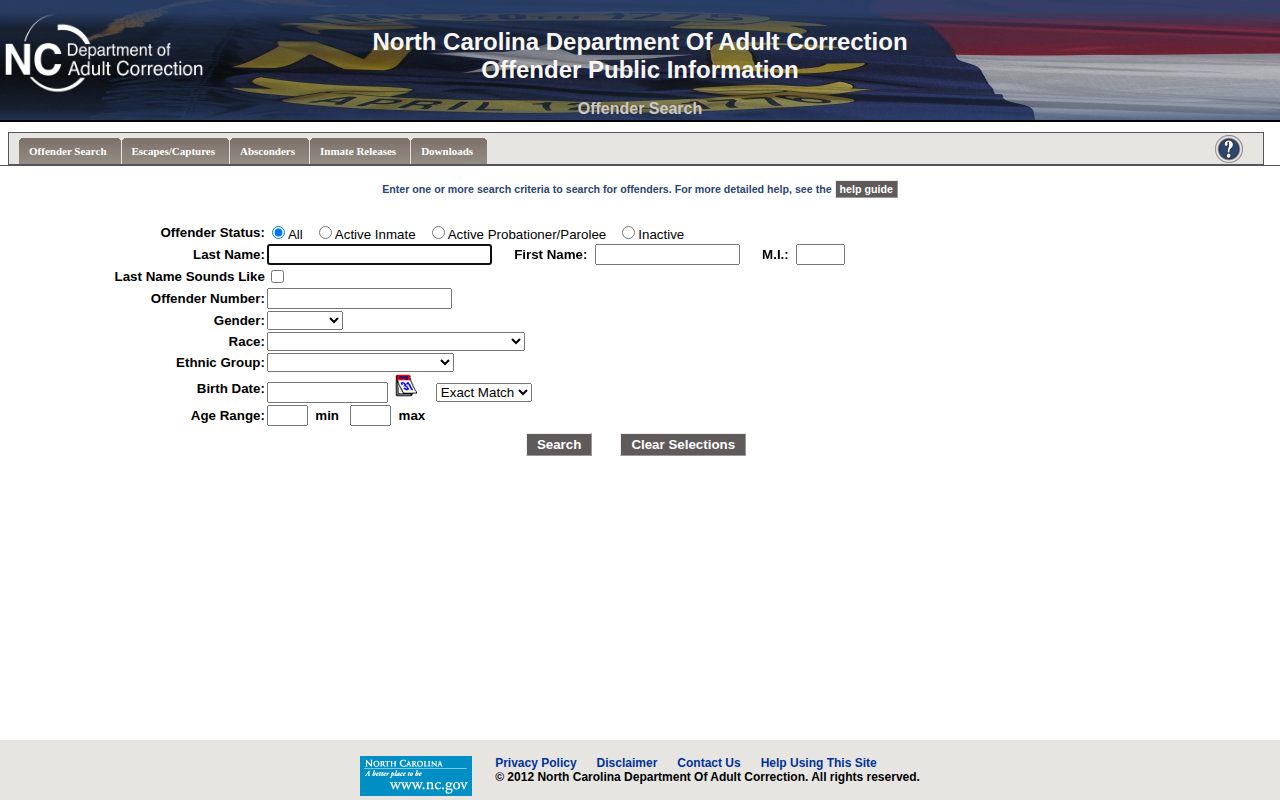
The form is a statewide state-prison and supervision source, not the Sampson County jail's released-person portal.
Sampson Release and Earned Time
North Carolina's Structured Sentencing framework is often shortened incorrectly to an “85% rule.” For crimes committed on or after October 1, 1994, the Commission explains that ordinary old-law parole was eliminated and the sentence structure requires at least 100% of the minimum and 85% of the maximum. Those two parts belong together. It is wrong to say every person simply serves 85% of a sentence.
G.S. 15A-1340.13(d) supplies the key limit. A person serving an active sentence must serve the minimum term. Earned time may reduce the maximum, but never below that minimum. Credits therefore do not erase the statutory minimum. The public projected date reflects the agency's sentence calculation, not arithmetic that can safely be rebuilt from a charge name or a docket line.
G.S. 148-13 directs the Secretary to adopt earned-time rules. It also requires applicable regulations to reach local jail administrators for sentenced jail prisoners and addresses discretionary DWI deductions in specified circumstances. The statute does not create one public “days per month” formula for every Sampson County inmate. Ask the custodian to explain a specific recorded calculation.
The Commission's structured-sentencing explanation is the source for this minimum and maximum distinction.
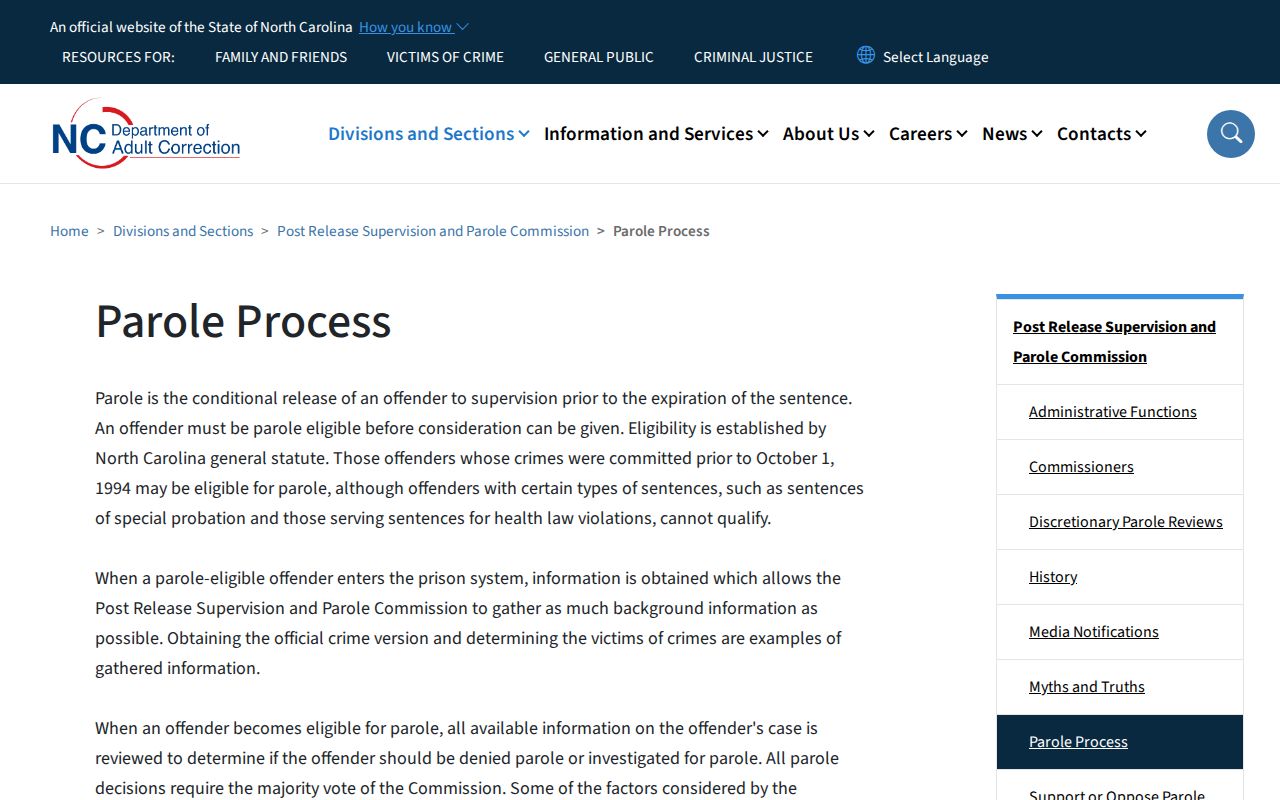
The state explanation supports reading a projected date from NCDAC instead of applying a flat percentage to a sentence.
Note: Earned time can affect the maximum calculation, but state law does not let it reduce an active term below the minimum.
Why Sampson Projected Release Changes
A projected date reflects the sentence data and credit rules in effect when NCDAC calculates it. Later legal or administrative events can alter the date or change what happens on that date. A detainer may mean the person leaves NCDAC for another authority rather than entering the community. A court order can change the sentence itself. Disciplinary or credit changes may alter an earned-time calculation. Older-law parole eligibility follows a separate Commission process and should not be mixed with modern PRS.
| Factor | Possible effect | Best confirmation |
|---|---|---|
| Earned-time calculation | Changes the maximum-side calculation but not below the minimum. | NCDAC sentence detail |
| Credit adjustment | May move the anticipated date when agency rules permit. | Current NCDAC calculation |
| Court order | Can alter the term or legal basis for custody. | Filed judgment and updated record |
| Detainer | Can lead to transfer to another authority. | Detainer field and receiving agency |
| Parole review | Applies to eligible older-law cases. | Commission and offender status |
| Post-release supervision | Changes the legal phase after prison. | Supervision status and office |
Do not use a countdown built from an alleged offense. A person can have more than one sentence-history row, a revocation, or different service statuses. Verify the right offender and sentence first. When the summary does not explain a component, contact NCDAC rather than infer it.
Sampson County Jail Release Dates
A Sampson County Detention Center booking follows a different date path from an NCDAC prison sentence. Sheriff Jimmy Thornton's office operates this county custody channel. The county's official lookup wrapper can route to released mode, where a booking may be classified as released. The sampled detail did not show an exact release timestamp, release reason, or projected date. Ask the Sheriff's Office for the release sheet when the physical exit or transfer event matters.
Pretrial release depends on the court and jail process, not earned time on a prison sentence. A bond may remain unposted, conditions may change, or administrative steps may continue after a court entry. A dismissal or other court outcome is also not the minute of physical exit. Compare the county custody record with the Sampson County court record, then let each source answer its own question. The court file supplies the judgment or disposition. The jail sheet supplies the local custody movement.
A locally sentenced jail prisoner may be subject to earned-time rules distributed under state law, but that does not make the person an NCDAC prison inmate. Contact the local custodian and court for the usable calculation. If the booking ends in transport to Sampson Correctional Institution or another NCDAC site, removal from the county roster is a transfer. Begin a new state search and do not label the handoff as community release.
Note: Sampson's county released portal proves its own classification, while the release sheet is needed for a precise time, reason, or destination.
Sampson Release and PRS Timing
Post-release supervision is a community phase that follows applicable felony prison terms. Under G.S. 15A-1368.2, the PRS release date is generally the maximum term less 12 months for Class B1 through E or less nine months for Class F through I, then adjusted for earned time. The statute includes a 60-month provision tied to the special maximum under G.S. 15A-1340.17(f). These rules explain why physical prison release can occur before the full maximum ends.
The statute also provides capped credit against PRS for compliance with certain reintegrative conditions and states that completion terminates the sentence. Exact application depends on the official record. It should not be reconstructed from a charge label. Inactive incarceration plus active post-release status usually means the person is in the community under supervision, absent a later custody event. Check the assigned Probation/Parole Office for the administrative location.
Probation is different because a judge may order it without prison. Parole also differs because it concerns discretionary release for eligible older-law cases. North Carolina's Commission does not hold formal public parole hearings, so there is no calendar to use as a substitute for the offender record.
Sampson State Inmate Release Dates
NCDAC maintains a second tool that looks backward. Its Inmate Releases search allows a Release County, year, and month query. Sampson is available as a release-county filter. Results show offender number, name, release date, primary offense and qualifier, and a release type such as EXPIRATION or PAROLE/RETURN TO PAR. This is useful after an anticipated date passes because it supplies an actual release-first view.
The Inmate Releases help page limits the report to the current calendar year and two prior years. It also offers a separate surname search. Those search sets cannot be combined. Offender Search has much longer history, so a blank result in the three-year report is not proof that no state release occurred.
“Release County” must not be overdefined. State help does not establish that it always means the prison facility, conviction county, or return address. Describe a match as reported under Sampson release county, then use full offender detail to verify the institution and movement. This state report does not cover someone released only from Sampson County Detention Center.
Confirm Sampson County Actual Release
After locating a projected date, monitor the official record for an Actual Release Date and a consistent movement. For a state prisoner, compare Offender Search with the recent Inmate Releases report. For a county jail detainee, use the sheriff's released mode to see whether the booking is classified as released, then request the release sheet for exact date, time, reason, or transfer destination. The county portal does not publish a projected-release field.
The Sampson County VINELink inmate search can add a release or custody-change alert when the live supplying agency and record offer registration. A no-result or delayed notice cannot replace the jail or NCDAC record. VINELink is an event-notification layer, not a certified sentence calculation.
Keep transfer and community release separate. If a detainer leads NCDAC or the jail to hand the person to another county, federal authority, or immigration custody, the first custody episode may end while confinement continues. Confirm the destination with the releasing agency. Only the receiving system establishes the next status.
Note: Use the actual-release field or release sheet after the event; never present the projected date as a guaranteed exit.